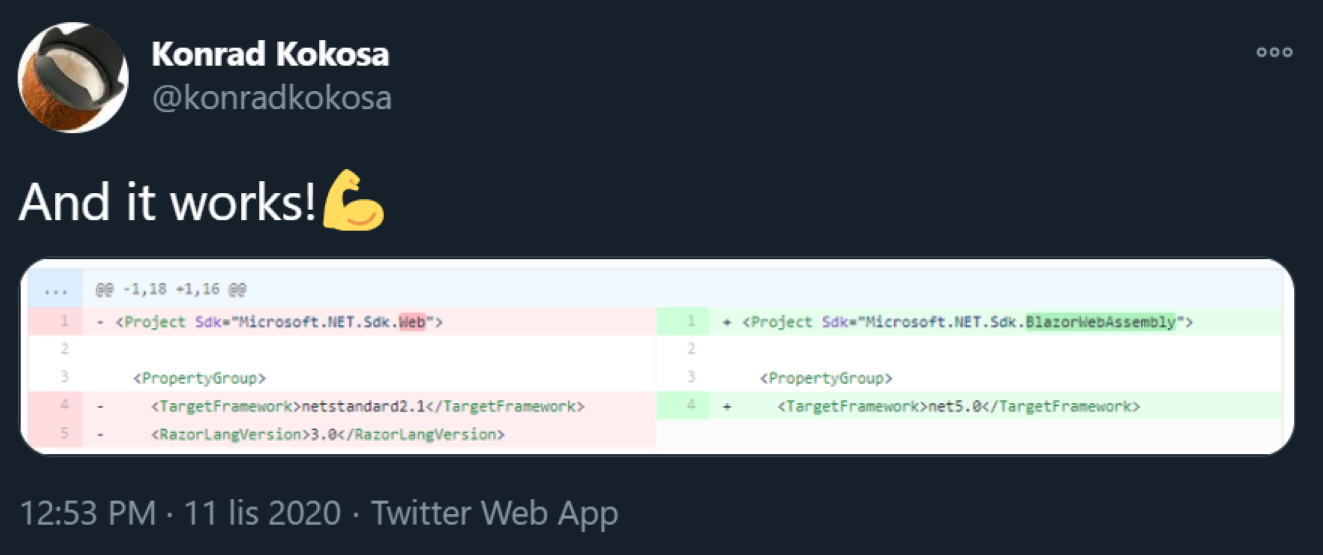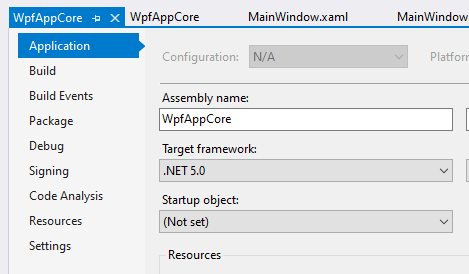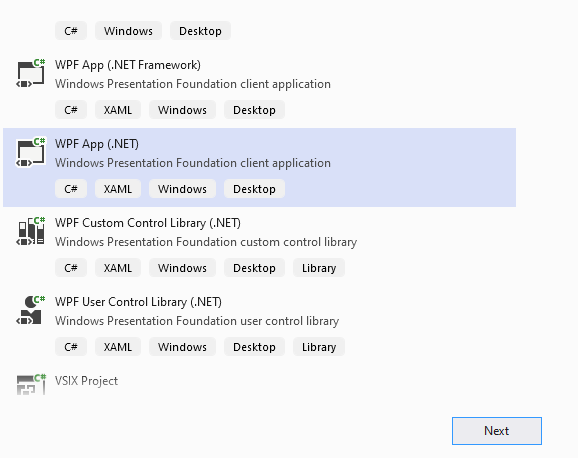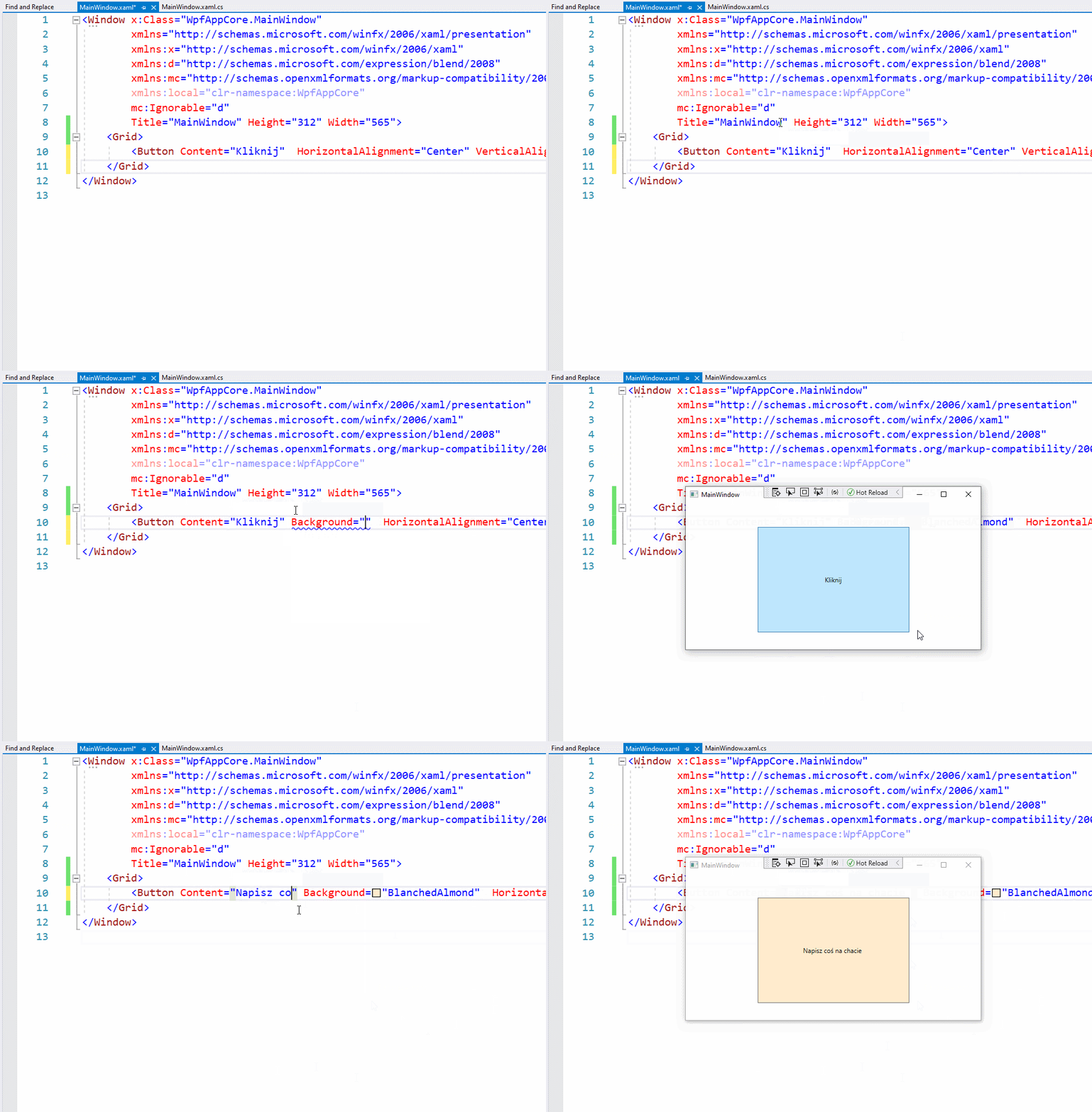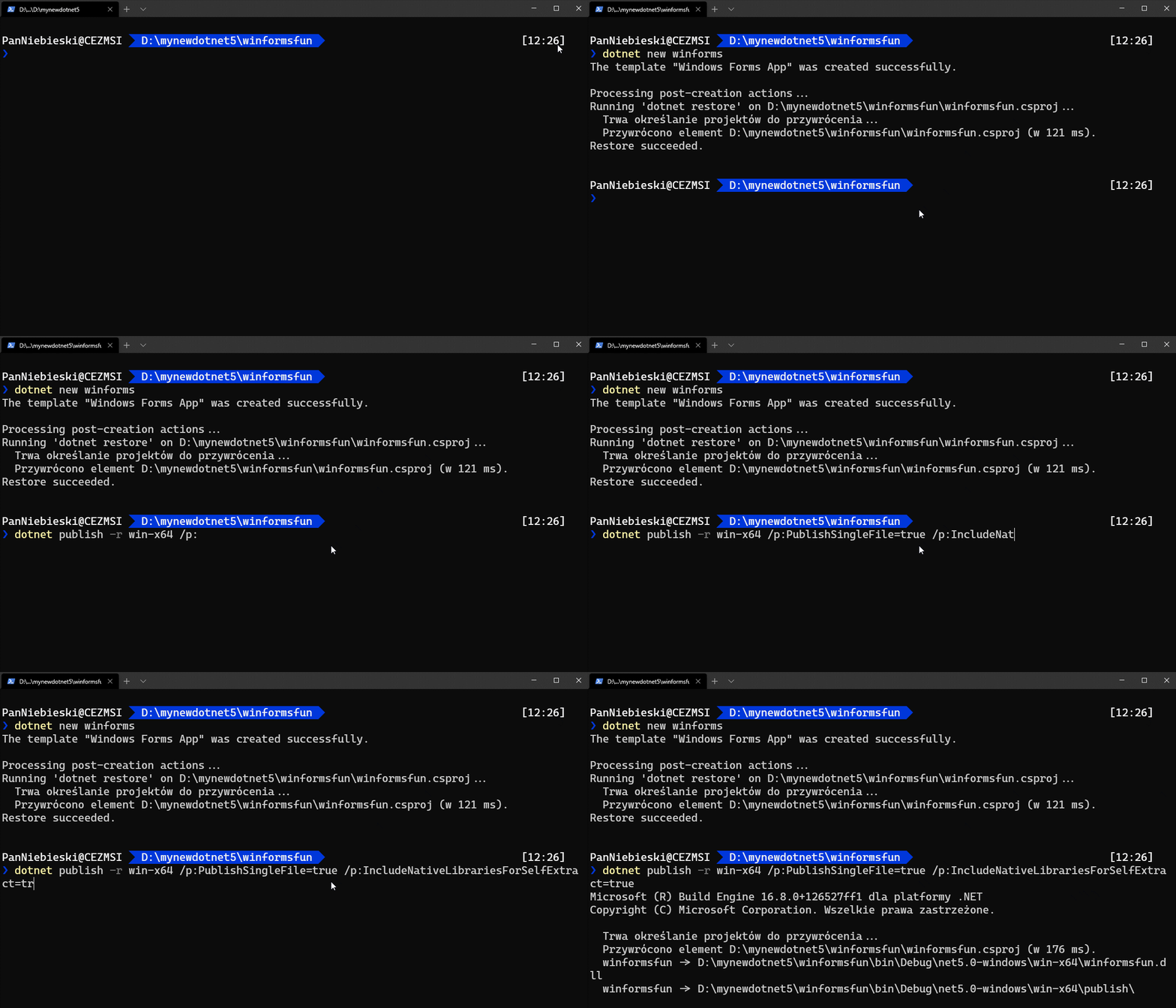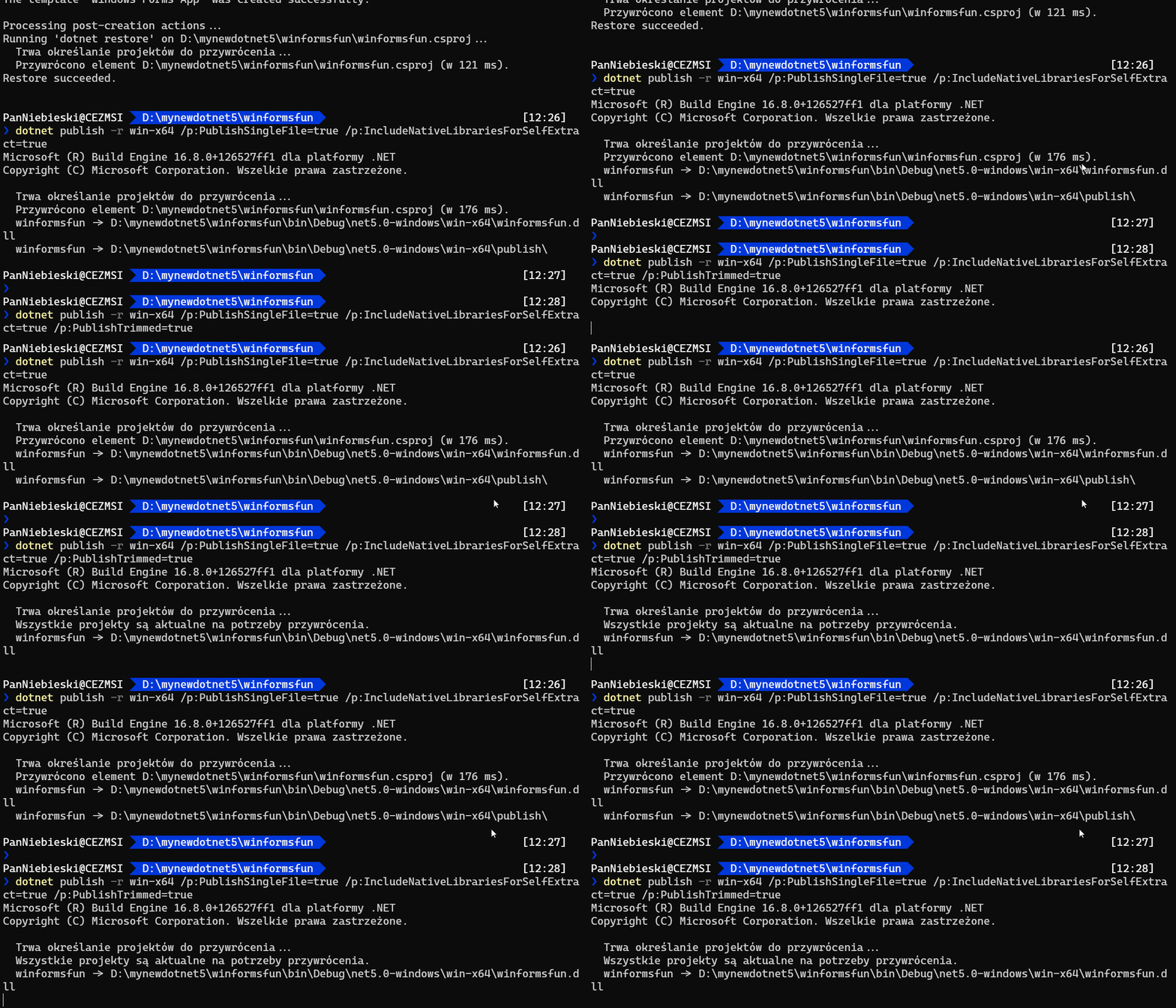
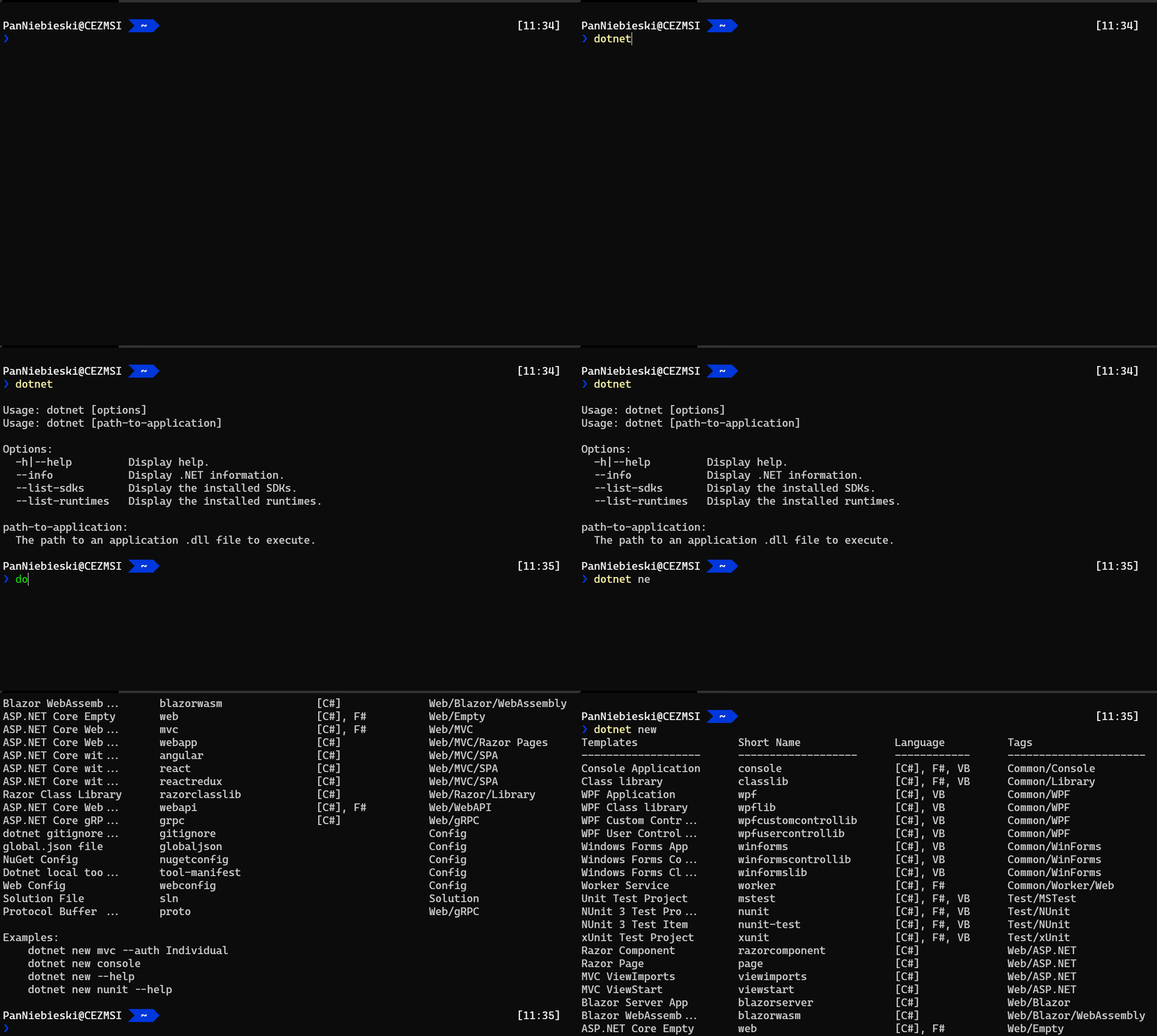
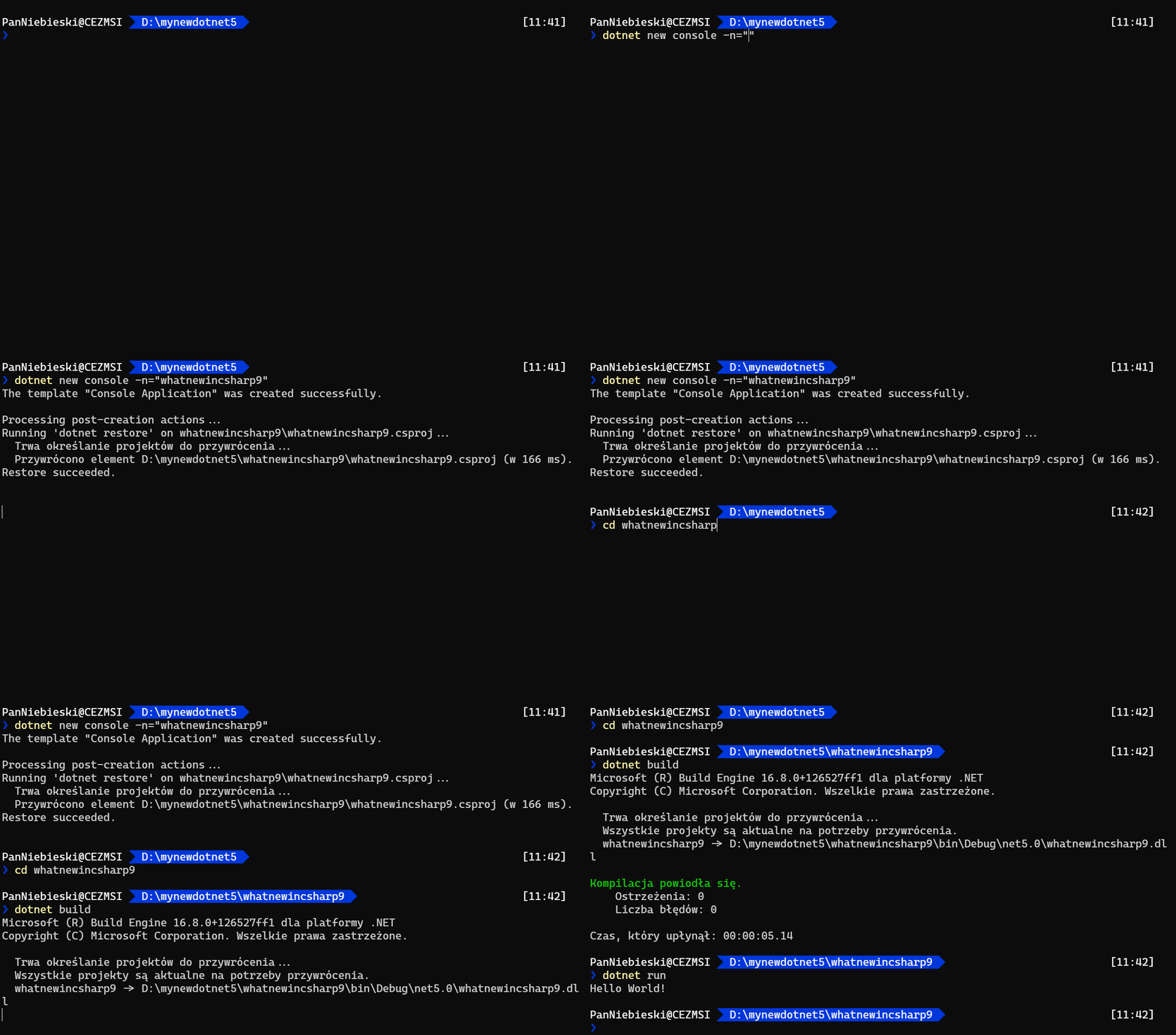
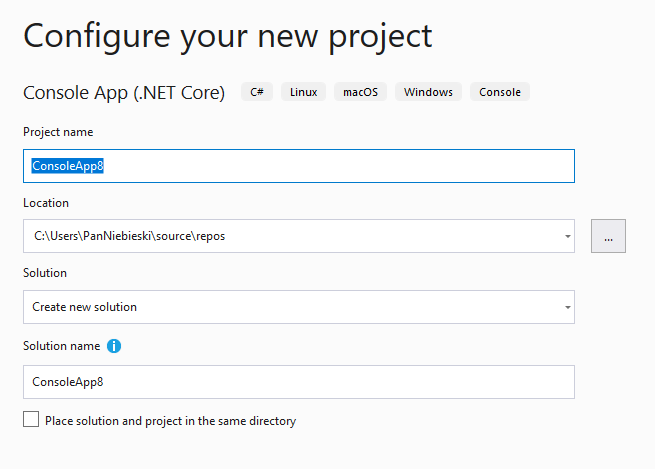
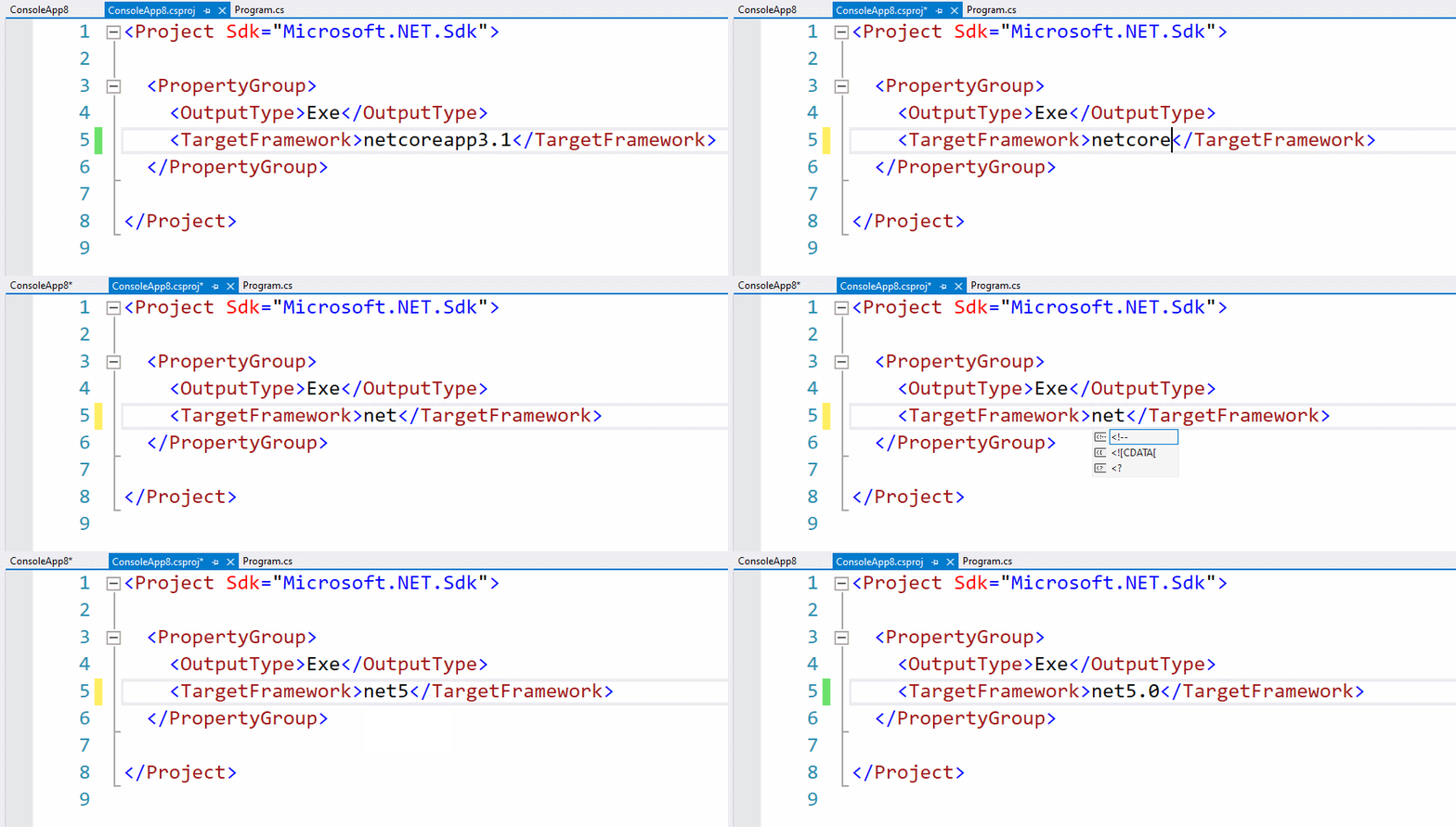
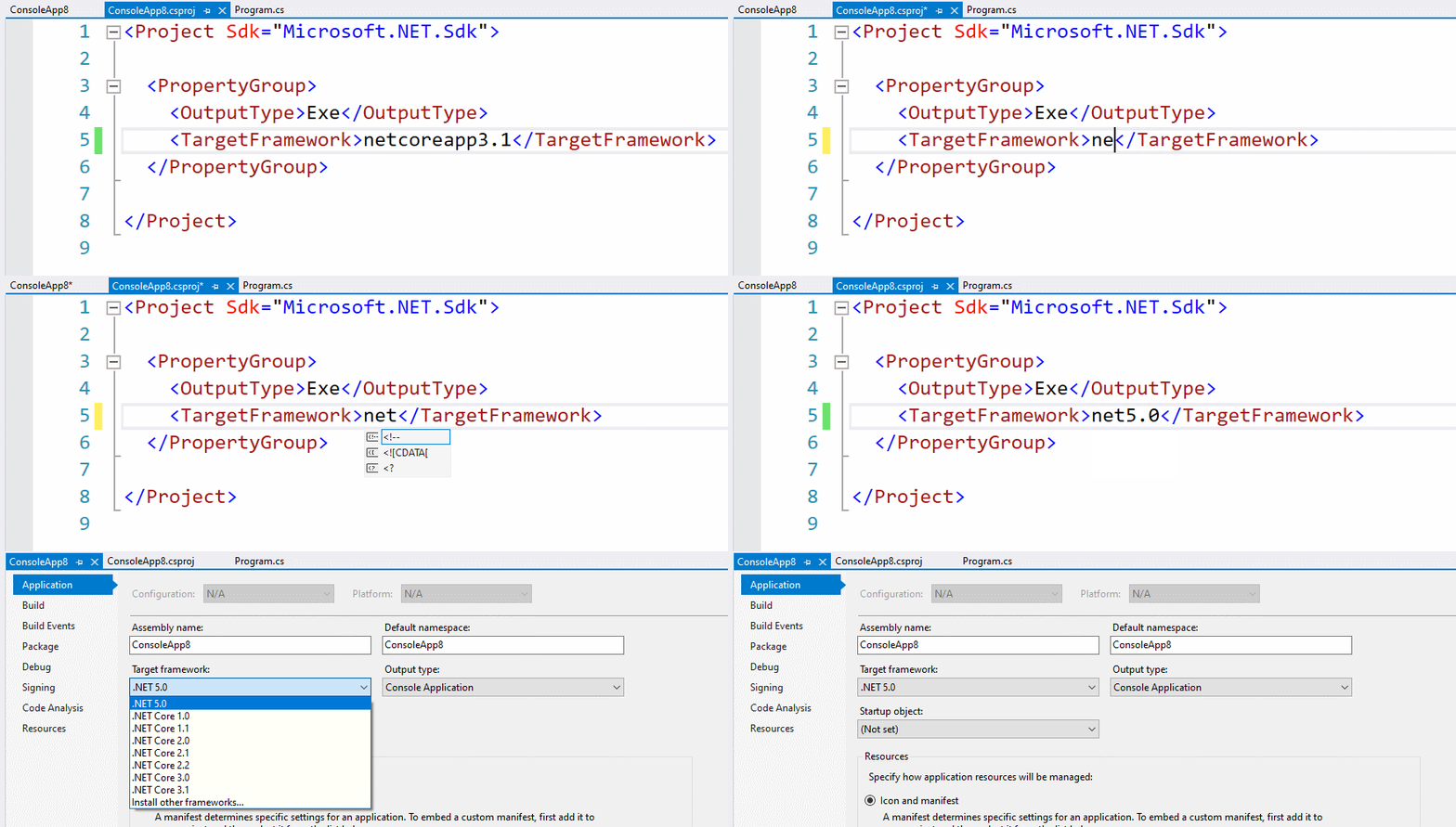
                        <Project Sdk="Microsoft.NET.Sdk">

                            <PropertyGroup>
                              <OutputType>Exe</OutputType>
                              <TargetFramework>netcoreapp3.1</TargetFramework>
                            </PropertyGroup>

                        </Project>

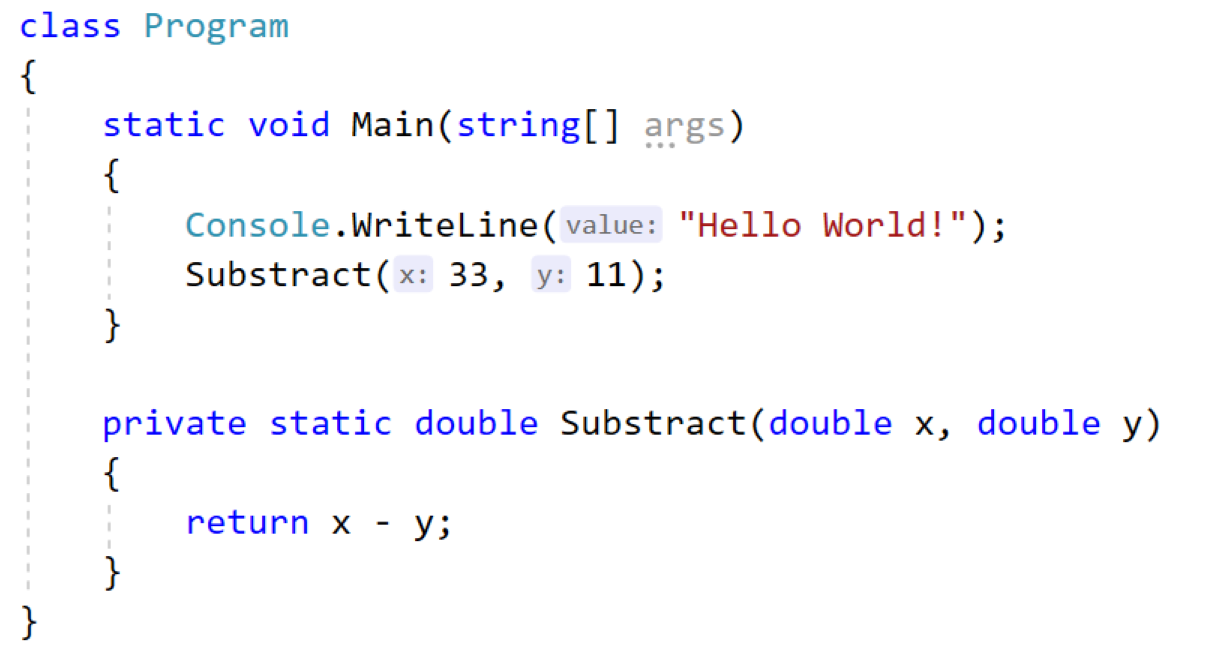
                        using System;

                        namespace ConsoleTopLevelCallsNot
                        {
                            class Program
                            {
                                static void Main(string[] args)
                                {
                                    Console.WriteLine("Hello World!");
                                    Console.WriteLine(Substract(33, 11));

                                }

                                private static double Substract(double x, double y)
                                {
                                    return x - y;
                                }
                            }
                        }
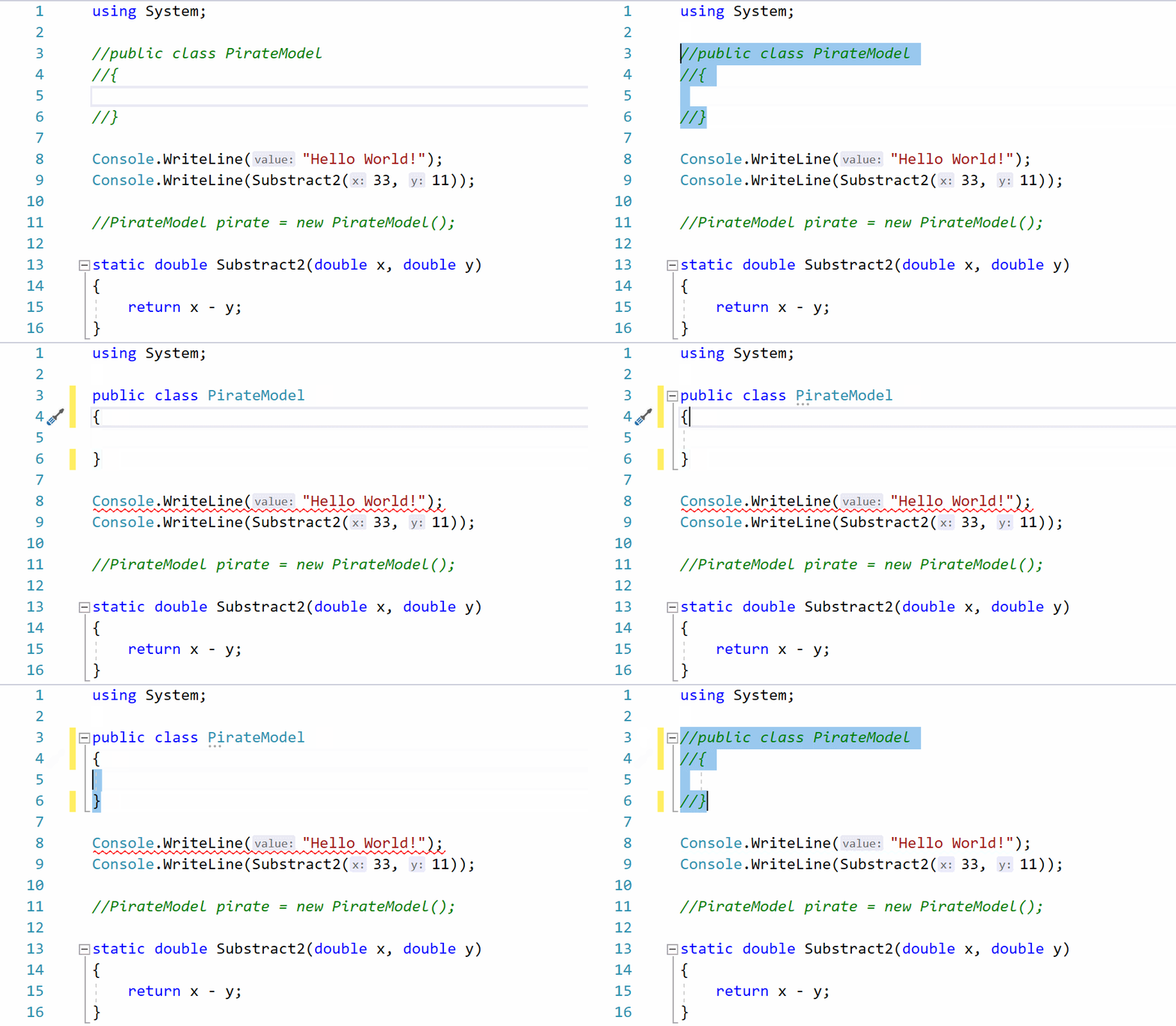
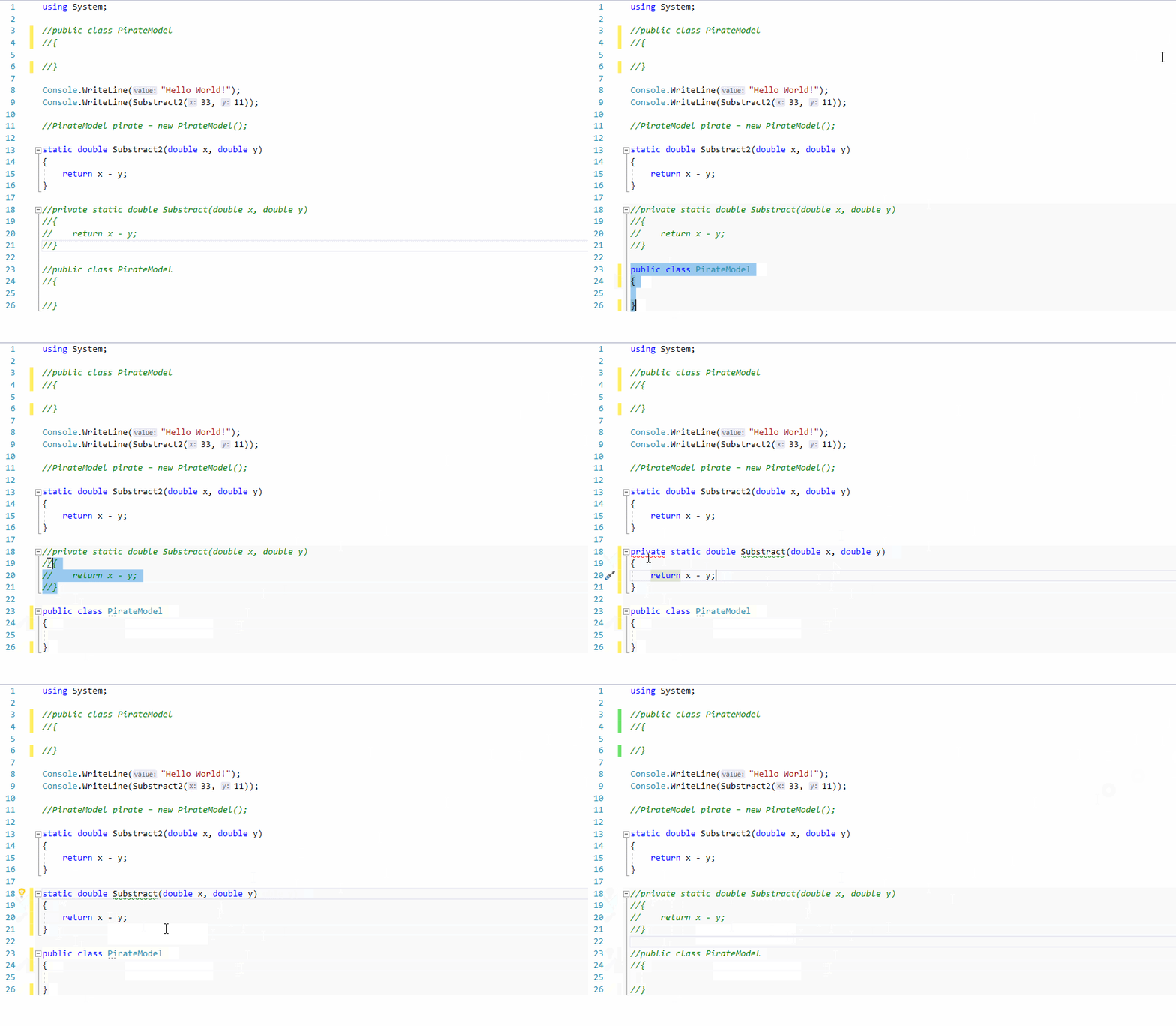
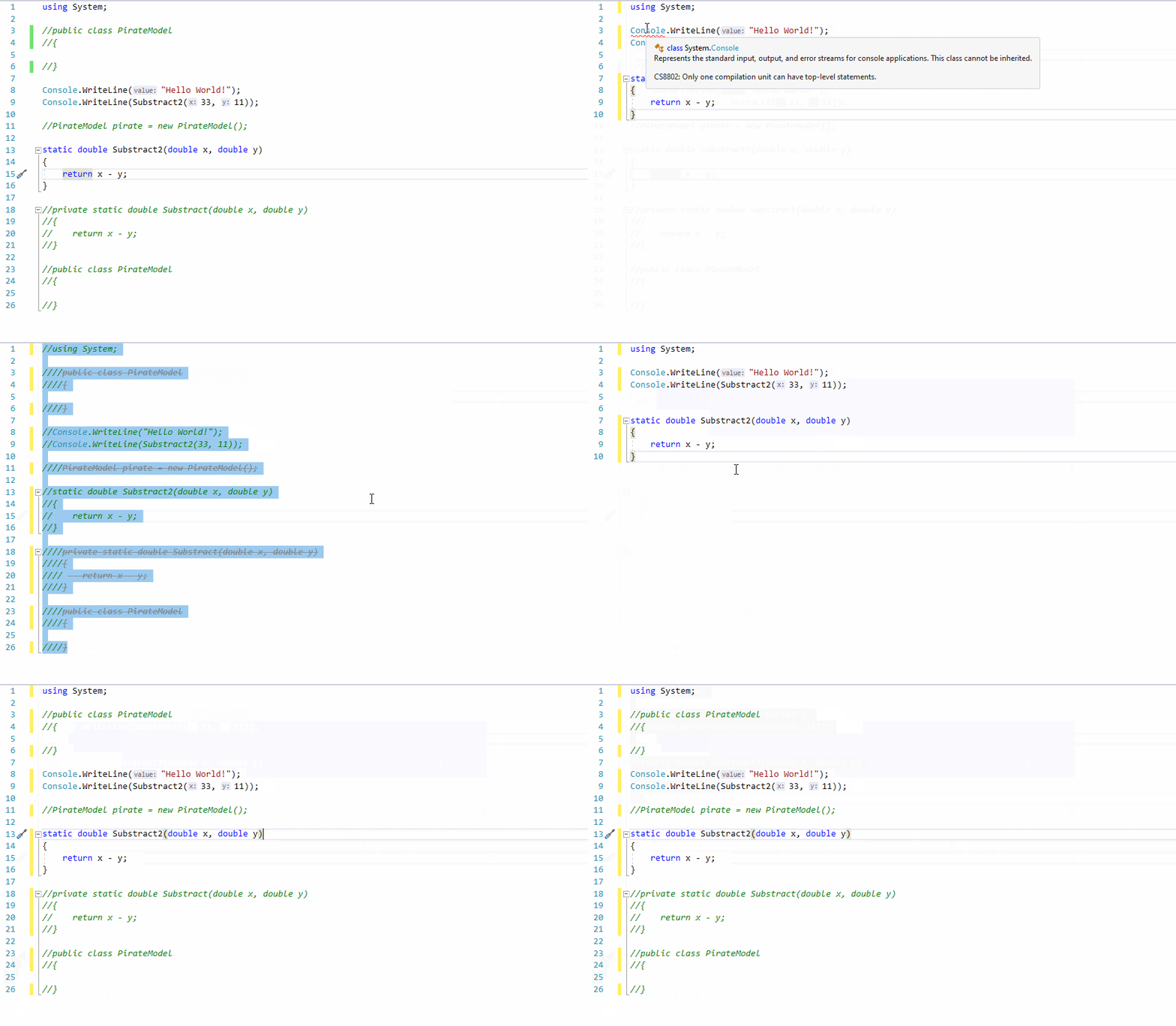
                        using System;

                        Console.WriteLine("Hello World!");
                        Console.WriteLine(Substract2(33, 11));

                        static double Substract2(double x, double y)
                        {
                            return x - y;
                        }
                        using System;

                        namespace ConsoleTopLevelCallsNot
                        {
                            class Program
                            {
                                static void Main(string[] args)
                                {
                                    if (args.Length == 0)
                                    {
                                        System.Console.WriteLine("Please enter a numeric argument.");
                                    }


                                }
                            }
                        }
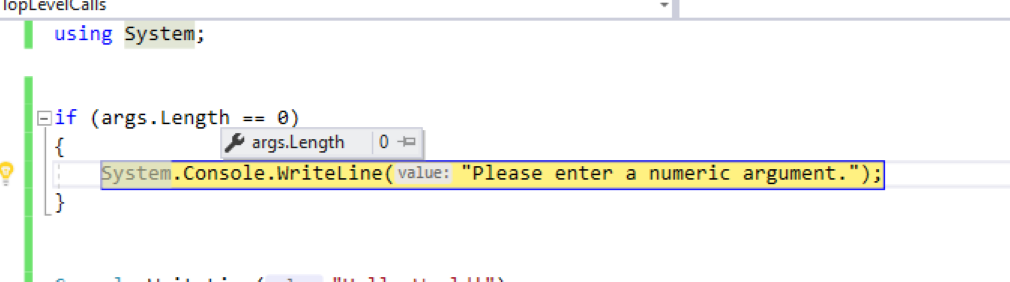
                        using System;

                        if (args.Length == 0)
                        {
                            System.Console.WriteLine("Please enter a numeric argument.");
                        }
                        public class PirateModel
                        {
                            public int Id { get; set; }

                            public string CrewName { get; set; }

                            public string Name { get; set; }
                        }
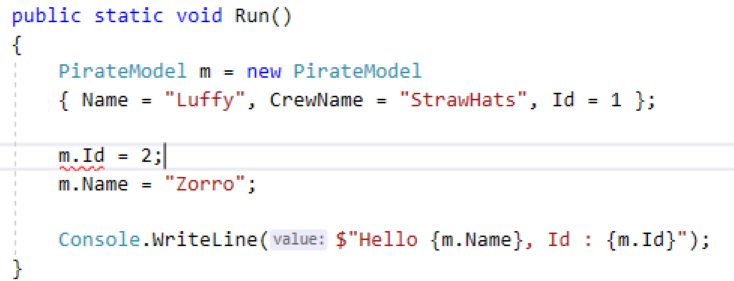
                        public static class InitialSetterExample
                        {
                            public static void Run()
                            {
                                PirateModel m = new PirateModel
                                { Name = "Luffy", CrewName = "StrawHats", Id = 1 };

                                m.Id = 2;
                                m.Name = "Zorro";

                                Console.WriteLine($"Hello {m.Name}, Id : {m.Id}");
                            }
                        }
                        public class PirateModel
                        {
                            public int Id { get; private set; }

                            public string CrewName { get; set; }

                            public string Name { get; set; }
                        }
                        public class PirateModel
                        {
                            public int Id { get; private set; }

                            public string CrewName { get; set; }

                            public string Name { get; set; }

                            public void UpdateId(int newId)
                            {
                                Id = newId;
                            }
                        }
                        public class PirateModel
                        {
                            public int Id { get; init; }

                            public string CrewName { get; set; }

                            public string Name { get; set; }
                        }
                        PirateModel m3 = new();

                        PirateModel m4 = new()
                        { Name = "Zorro", CrewName = "StrawHats", Id = 2 };

                        //var m5 = new();
                        PirateModel m6;

                        //1000 linjek kodu później

                        m6 = new();
                        public class Weather
                        {
                            public DateTime Date { get; set; }

                            public int TemperatureC { get; set; }

                            public string Desc { get; set; }
                        }
                        public static List<Weather> CreateExample()
                        {
                            DateTime now = DateTime.Now;
                            var rng = new Random();

                            var exampleCollection = Enumerable.Range(1, 14).Select
                                (index => new Weather
                                {
                                    Date = now.AddDays(index),
                                    TemperatureC = rng.Next(-10, 40)
                                }
                            ).ToList();

                            return exampleCollection;
                        }
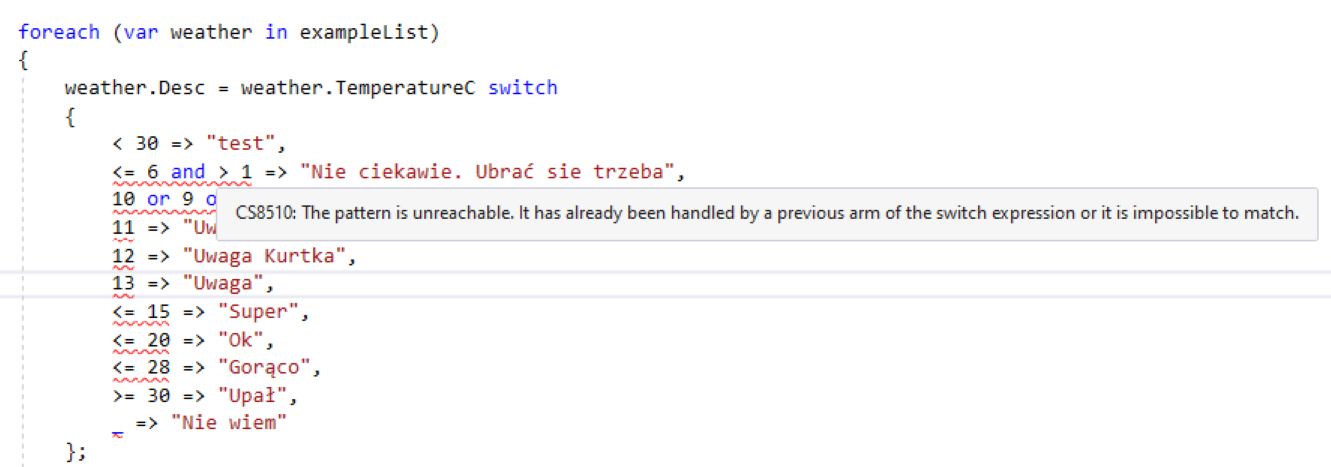
                        foreach (var weather in exampleList)
                        {
                            weather.Desc = weather.TemperatureC switch
                            {
                                <= 6 and > 1 => "Nie ciekawie. Ubrać sie trzeba",
                                10 or 9 or 8 or 7 => "Zimno",
                                11 => "Uwaga Łatwo zachorować",
                                12 => "Uwaga Kurtka",
                                13 => "Uwaga",
                                <= 15 => "Super",
                                <= 20 => "Ok",
                                <= 28 => "Gorąco",
                                >= 30 => "Upał",
                                _ => "Nie wiem"
                            };
                        }
                        public class Pizza
                        {
                            public string Name { get; set; }

                            public bool HasMeat { get; set; }

                            public bool HasAnanas { get; set; }

                            public void Deconstruct(out string name, out bool hasMeat, out bool hasAnanas)
                            {
                                name = Name;
                                hasMeat = HasMeat;
                                hasAnanas = HasAnanas;
                            }
                        }
                        public class Pizza
                        {
                            public string Name { get; set; }

                            public bool HasMeat { get; set; }

                            public bool HasAnanas { get; set; }

                            public void Deconstruct(out string name, out bool hasMeat, out bool hasAnanas)
                            {
                                name = Name;
                                hasMeat = HasMeat;
                                hasAnanas = HasAnanas;
                            }

                            public string Desc { get; set; }
                        }
                        public static List<Pizza> CreateExample()
                        {
                            var rng = new Random();

                            var exampleCollection = Enumerable.Range(1, 14).Select
                                (index => new Pizza
                                {
                                    Name = "P" + index.ToString() + rng.Next(1, 10).ToString(),
                                    HasMeat = rng.NextDouble() >= 0.5,
                                    HasAnanas = rng.NextDouble() >= 0.5
                                }
                            ).ToList();

                            return exampleCollection;
                        }
                        Pizza a = new Pizza() { HasAnanas = false, HasMeat = true, Name = "Marinara" };
                        Pizza b = new Pizza() { HasAnanas = false, HasMeat = true, Name = "Peperoni" };

                        var (name, hasananas, hasmeat) = a;
                        var (name2, hasananas2, hasmeat2) = b;
                        var exampleList = CreateExample();

                        Pizza a = new Pizza() { HasAnanas = false, HasMeat = true, Name = "Marinara" };
                        Pizza b = new Pizza() { HasAnanas = false, HasMeat = true, Name = "Peperoni" };
                        exampleList.Add(b); exampleList.Add(a);

                        foreach (var pizza in exampleList)
                        {
                            pizza.Desc = pizza switch
                            {
                                ("1", true, false) => "Taką zjem",
                                ("2", true, true) => "Ujdzie",
                                ("Peperoni", _, _) => "Moja ulubiona",
                                ("Marinara", _, _) => "Często jadam",
                                (_, _, true) => "Tej nie zjem",
                                _ => "Nie wiem"
                            };
                        }
                        var exampleList = CreateExample();

                        Pizza a = new Pizza() { HasAnanas = false, HasMeat = true, Name = "Marinara" };
                        Pizza b = new Pizza() { HasAnanas = false, HasMeat = true, Name = "Peperoni" };
                        exampleList.Add(b); exampleList.Add(a);

                        foreach (var pizza in exampleList)
                        {
                            pizza.Desc = pizza switch
                            {
                                ("2", _, var czymaAnans) => $"Pizza z Ananasem : {czymaAnans}",
                                { HasMeat : true} => "Ma mieso"
                            };
                        }
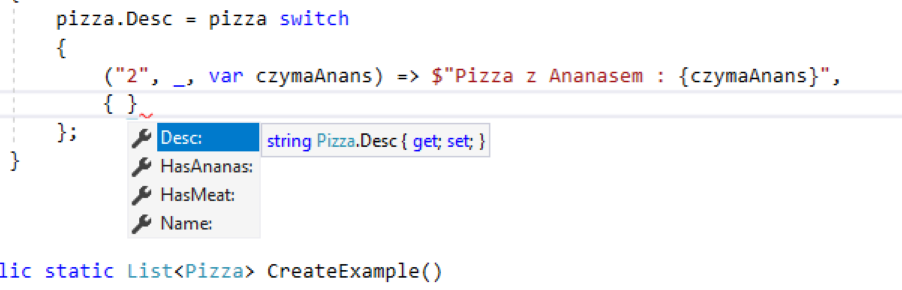
                        var exampleList = CreateExample();

                        Pizza a = new Pizza() { HasAnanas = false, HasMeat = true, Name = "Marinara" };
                        Pizza b = new Pizza() { HasAnanas = false, HasMeat = true, Name = "Peperoni" };
                        exampleList.Add(b); exampleList.Add(a);

                        foreach (var pizza in exampleList)
                        {
                            pizza.Desc = pizza switch
                            {
                                ("2", _, var czymaAnans) => $"Pizza z Ananasem : {czymaAnans}",
                            };
                        }
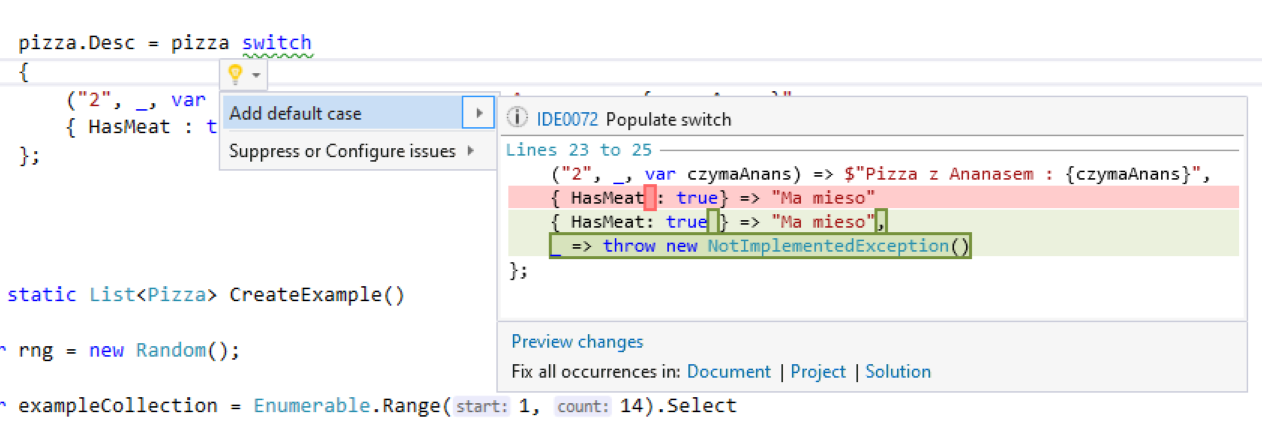
                        var exampleList = CreateExample();

                        Pizza a = new Pizza() { HasAnanas = false, HasMeat = true, Name = "Marinara" };
                        Pizza b = new Pizza() { HasAnanas = false, HasMeat = true, Name = "Peperoni" };
                        exampleList.Add(b); exampleList.Add(a);

                        foreach (var pizza in exampleList)
                        {
                            pizza.Desc = pizza switch
                            {
                                ("2", _, var czymaAnans) => $"Pizza z Ananasem : {czymaAnans}",
                                (HasMeat: true) => $"Ma mieso",
                                _ => throw new NotImlementedException()
                            };
                        }
                        var exampleList = CreateExample();

                        Pizza a = new Pizza() { HasAnanas = false, HasMeat = true, Name = "Marinara" };
                        Pizza b = new Pizza() { HasAnanas = false, HasMeat = true, Name = "Peperoni" };
                        exampleList.Add(b); exampleList.Add(a);

                        foreach (var pizza in exampleList)
                        {
                            pizza.Desc = (pizza.HasMeat, pizza.HasAnanas) switch
                            {
                                (true, false) => "Super",
                                (false, true) => "Poprostu nie",
                                (false, false) => "Bez mięsa ?"
                            };
                        }
                        public class GreenTest : Test
                        {

                        }

                        public class RedTest : Test
                        {

                        }

                        public class Test
                        {

                        }
                        public static List<Test> CreateExample()
                        {
                            var rng = new Random();

                            List<Test> tests = new List<Test>();

                            for (int i = 0; i < 15 ; i++)
                            {
                                if (rng.Next(1,100)  % 2 == 0)
                                    tests.Add(new GreenTest());
                                else
                                    tests.Add(new RedTest());
                            }

                            return tests;
                        }
                        var exampleList = CreateExample();

                        foreach (var test in exampleList)
                        {
                            string outcome = test switch
                            {
                                GreenTest => "Postive",
                                RedTest => "Negative",
                                _ => "unknow"
                            };
                            Console.WriteLine(outcome);
                        }
                        public class GreenTest : Test
                        {

                        }

                        public class RedTest : Test
                        {

                        }

                        public class Test
                        {
                            public bool IsValid { get; set; }
                            public DateTimeOffset TestedOn { get; set; }

                            public void Deconstruct(out int minutesSinceTest, out bool isValid)
                            {
                                minutesSinceTest = (int)(DateTimeOffset.UtcNow - TestedOn).TotalMinutes;
                                isValid = IsValid;
                            }
                        }
                        var exampleList = CreateExample();

                        foreach (var test in exampleList)
                        {
                            string outcome = test switch
                            {
                                ( < 60 * 24 * 2, false) => "Nie poprawny test których jest młodszy niż 2 dni",
                                GreenTest(> 60 * 24, true) => "Postive, ale warto go po 24 godzinach zrobić ponownie",
                                _ => "unknow"
                            };
                            Console.WriteLine(outcome);
                        }
                        PirateModel m1 = new PirateModel
                        { Name = "Luffy", CrewName = "StrawHats", Id = 1 };

                        PirateModel m2 = new()
                        { Name = "Zorro", CrewName = "StrawHats", Id = 2 };

                        PirateModel m3 = null;

                        if (m3 is null)
                        {

                        }

                        if (m2 is not null)
                        {

                        }

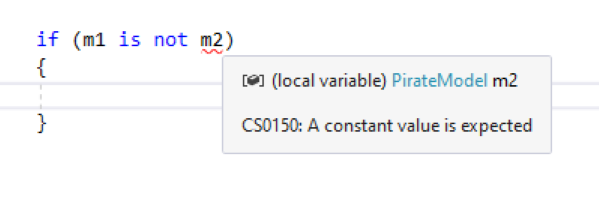
                        //if (m1 is not m2)
                        //{

                        //}
                        public record Record1(int  FirstNumber, int SecondNumber);

                        //Czy Rekordy są typem wartościowym,
                        //Czy typem referencyjnym?
                        Record1 rA = new(1, 2);
                        Record1 rAtest = rA;
                        Console.WriteLine(ReferenceEquals(rA, rAtest));

                        //true
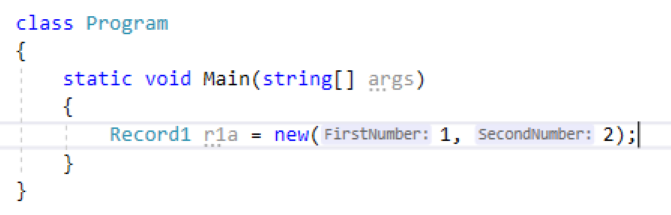
                        //Czy rekord jako klasa wygląda tak

                        public class Record2
                        {
                            public string FirstNumber { get; set; }

                            public string SecondNumber { get; set; }
                        }
                        //Podobne do tej klasy, ale to jednak nie to samo
                        //o tym za chwilę

                        public class Record3
                        {
                            public string FirstNumber { get; init; }

                            public string SecondNumber { get; init; }

                            public Record3(string firstName, string lastName)
                            {
                                FirstName = firstName;
                                LastName = lastName;
                            }
                        }
                        //To jest poprawny rekord

                        public record Record4
                        {
                            public int Number1 { get; set; }
                            public int Number2 { get; set; }
                        }
                        public record Record1(string FirstName, string LastName);

                        //Jest immutable czyli wartości w nim nie mogą być zmienione
                        //Tutaj jest problem z nie jasnym działem rekordu

                        public record Record4
                        {
                            public int Number1 { get; set; }
                            public int Number2 { get; set; }
                        }
                        //rekord to klasa tylko innaczej napisana
                        public record Record1(int FirstNumber, int SecondNumber);
                        public class Class3
                        {
                            public int FirstNumber { get; init; }

                            public int SecondNumber { get; init; }

                            public Class3(int firstNumber, int secondNumber)
                            {
                                FirstNumber = firstNumber;
                                SecondNumber = secondNumber;
                            }
                        }
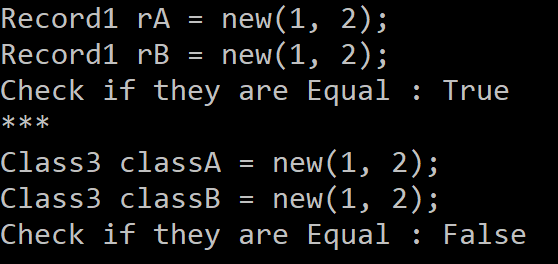
                        Record1 rA = new(1, 2);
                        Record1 rB = new(1, 2);
                        Record1 rC = new(100, 200);

                        Class3 classA = new(1, 2);
                        Class3 classB = new(1, 2);
                        Class3 classC = new(100, 200);
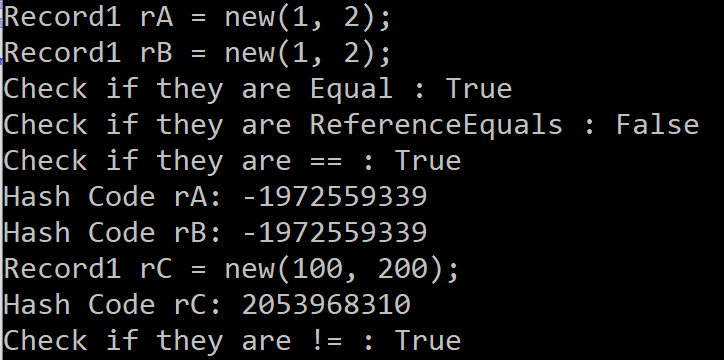
                        Console.WriteLine($"Record1 rA = new(1, 2);");
                        Console.WriteLine($"Record1 rB = new(1, 2);");
                        Console.WriteLine($"Check if they are Equal : {Equals(rA, rB)}");

                        Console.WriteLine("***");

                        Console.WriteLine($"Class3 classA = new(1, 2);");
                        Console.WriteLine($"Class3 classB = new(1, 2);");
                        Console.WriteLine($"Check if they are Equal : {Equals(classA, classB)}");
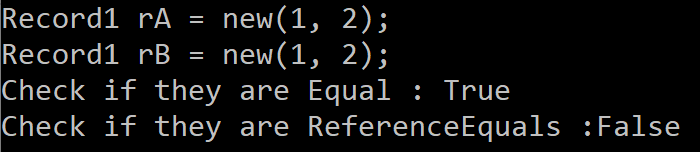
                        Console.WriteLine($"Record1 rA = new(1, 2);");
                        Console.WriteLine($"Record1 rB = new(1, 2);");

                        Console.WriteLine($"Check if they are Equal : {Equals(rA, rB)}");

                        Console.WriteLine($"Check if they are ReferenceEquals :" +
                            $"{ ReferenceEquals(rA, rB)}");
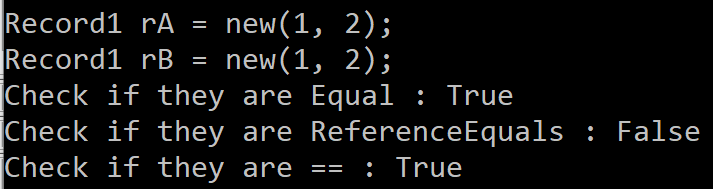
                        Console.WriteLine($"Record1 rA = new(1, 2);");
                        Console.WriteLine($"Record1 rB = new(1, 2);");

                        Console.WriteLine($"Check if they are Equal : {Equals(rA, rB)}");

                        Console.WriteLine($"Check if they are ReferenceEquals
                        : {ReferenceEquals(rA, rB)}");

                        Console.WriteLine($"Check if they are == : {rA == rB}");
                        Console.WriteLine($"Record1 rA = new(1, 2);");
                        Console.WriteLine($"Record1 rB = new(1, 2);");

                        Console.WriteLine($"Check if they are Equal : {Equals(rA, rB)}");

                        Console.WriteLine($"Check if they are ReferenceEquals :
                        {ReferenceEquals(rA, rB)}");

                        Console.WriteLine($"Check if they are == : {rA == rB}");

                        Console.WriteLine($"Hash Code rA: {rA.GetHashCode()}");
                        Console.WriteLine($"Hash Code rB: {rB.GetHashCode()}");
                        Console.WriteLine($"Record1 rC = new(100, 200);");
                        Console.WriteLine($"Hash Code rC: {rC.GetHashCode()}");

                        Console.WriteLine($"Check if they are != : {rA != rC}");
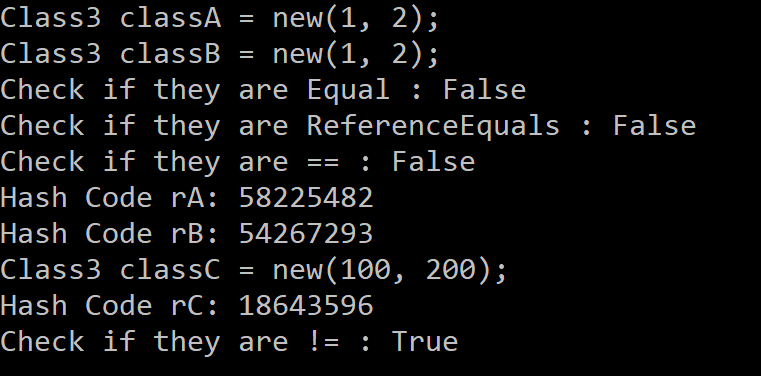
                        Console.WriteLine($"Record3 classA = new(1, 2);");
                        Console.WriteLine($"Record3 classB = new(1, 2);");

                        Console.WriteLine($"Check if they are Equal : {Equals(classA, classB)}");
                        Console.WriteLine($"Check if they are ReferenceEquals :
                        {ReferenceEquals(classA, classB)}");

                        Console.WriteLine($"Check if they are == : {classA == classB}");

                        Console.WriteLine($"Hash Code rA: {classA.GetHashCode()}");
                        Console.WriteLine($"Hash Code rB: {classB.GetHashCode()}");
                        Console.WriteLine($"Record3 classC = new(100, 200);");
                        Console.WriteLine($"Hash Code rC: {classC.GetHashCode()}");

                        Console.WriteLine($"Check if they are != : {classA != classC}");
                        Record1 rA = new(1, 2);

                        var (a, b) = rA;


                        public class Record3
                        {
                            public int FirstNumber { get; init; }

                            public int SecondNumber { get; init; }

                            public Record3(int firstNumber, int secondNumber)
                            {
                                FirstNumber = firstNumber;
                                SecondNumber = secondNumber;
                            }

                            public void Deconstruct(out int FirstNumber, out int SecondNumber)
                            {
                                FirstNumber = this.FirstNumber;
                                SecondNumber = this.SecondNumber;
                            }
                        }

                        Record1 rA = new(1, 2);
                        Record1 rAtest = rA;
                        Console.WriteLine(ReferenceEquals(rA, rAtest));

                        Record1 newRa = rA with
                        {
                            SecondNumber = 200
                        };
public record Data<T>(int id, T Data);
                        public interface IProduct<T>
                        {
                           T Data { get; }
                        }

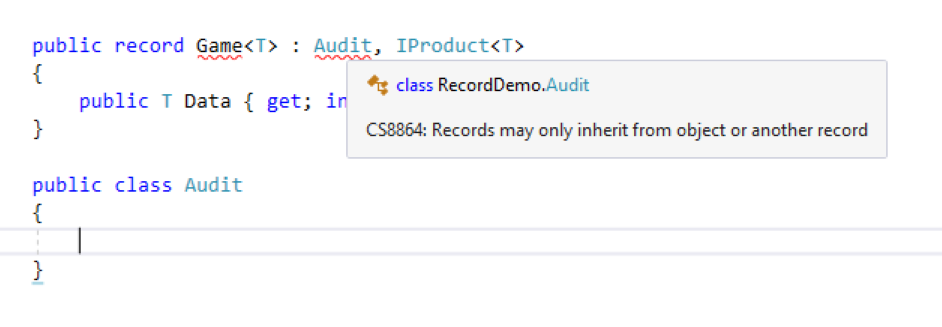
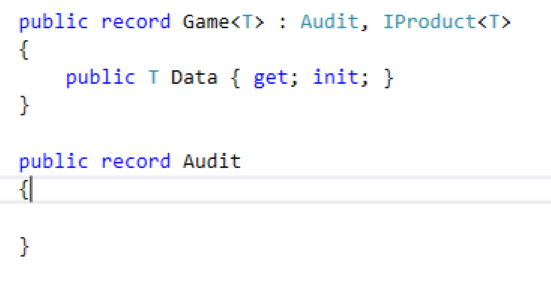
                        public record Game<T> : Audit ,IProduct<T>
                        {
                            public T Data { get; init; }
                        }
public partial record Data(string Name);
                        public record Data([property:JsonPropertyName("dataName")] string Name,
                           [property:JsonPropertyName("dataCity")]string City);


                        public record Data([field:Foo("field")][property:Foo("prop")] string Name);
                        [AttributeUsage(AttributeTargets.All)]
                        class MyAttribute : Attribute
                        {
                           public MyAttribute(string _) { }
                        }

                        public record Data([My("param")][field:My("field")][property:My("prop")] string Name);
                        public record Numbers
                        {
                            [JsonPropertyName("One")]
                            public string First { get; init; }

                            [JsonPropertyName("Two")]
                            public string Second { get; init; }
                        }
                        //To jest tutaj problem z nie jasnym działem rekordu

                        public record Record4
                        {
                            public int Number1 { get; set; }
                            public int Number2 { get; set; }
                        }
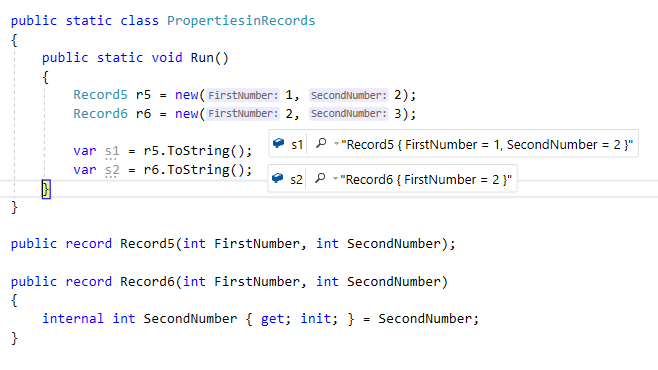
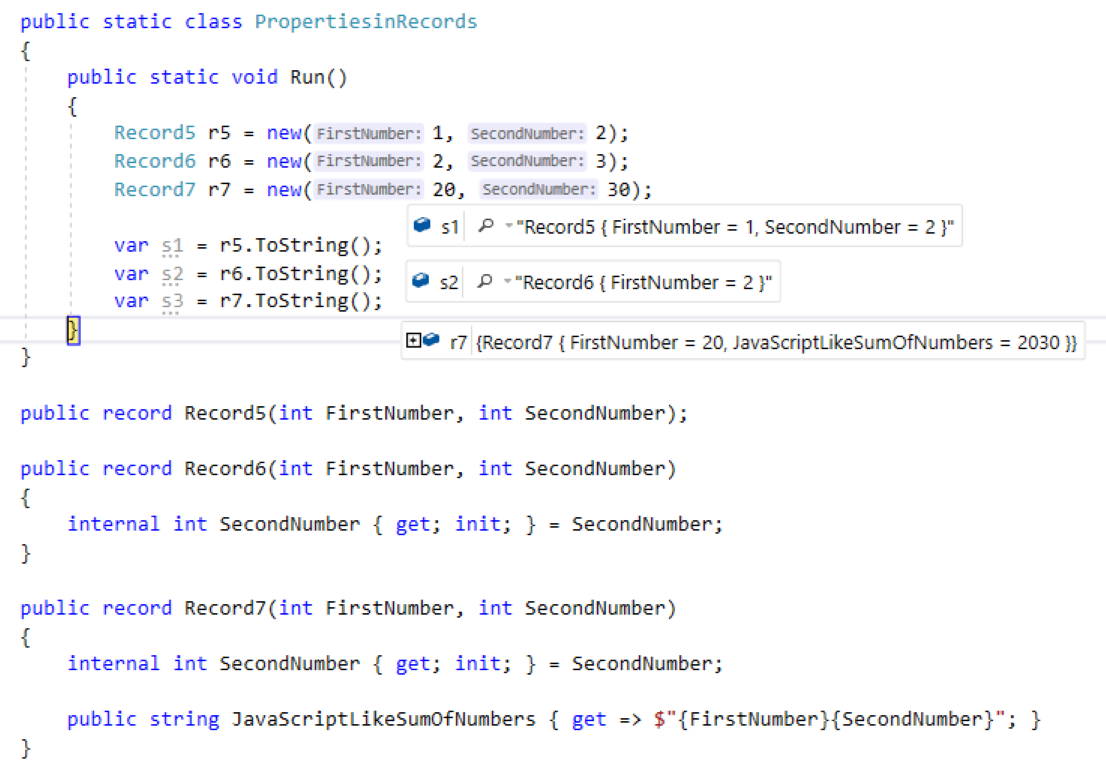
                        public record Record5(int FirstNumber, int SecondNumber);

                        public record Record6(int FirstNumber, int SecondNumber)
                        {
                            internal int SecondNumber { get; init; } = SecondNumber;
                        }
                        public record Record7(int FirstNumber, int SecondNumber)
                        {
                            internal int SecondNumber { get; init; } = SecondNumber;

                            public string JavaScriptLikeSumOfNumbers { get => $"{FirstNumber}{SecondNumber}"}
                        }
                        public record Record8(int FirstNumber, int SecondNumber)
                        {
                            public (int,int) ReturnHasCodes()
                            {
                                return (FirstNumber.GetHashCode(), SecondNumber.GetHashCode());
                            }
                        }
                        nint nativeInt = 55;

                        Console.WriteLine(nint.MaxValue);

                        Compiled in x86 Configuration
                        Output: 2147483647
                        Compiled in x64 Configuration
                        Output: 9223372036854775807
Func<int,int,int> zero = (_,_) => 0;
                        partial class Doing
                        {
                            internal partial bool DoSomething(string s, out int i);
                        }

                        partial class Doing
                        {
                            internal partial bool DoSomething(string s, out int i)
                            {
                                i = 0;
                                return true;
                            }
                        }
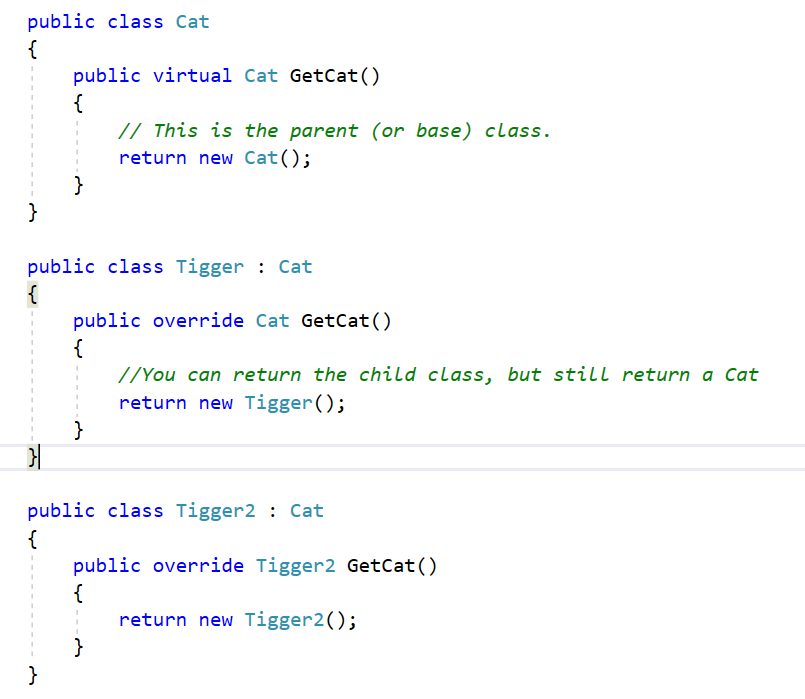
                        public virtual Cat GetCat()
                        {
                            // This is the parent (or base) class.
                            return new Cat();
                        }

                        public override Cat GetCat
                        {
                            //You can return the child class, but still return a Cat
                            return new Tigger();
                        }
                        public virtual Cat GetCat()
                        {
                            // This is the parent (or base) class.
                            return new Cat();
                        }

                        public override Tiger GetCat()
                        {
                            return new Tigger();
                        }
                        public static class Extensions
                        {
                            public static IEnumerator<T> GetEnumerator<T> (this IEnumerator<T> enumerator) =>
                        }